

What is this?
On Operations and Hilarity

I sing the body electric
The armies of those I love . . .
And if the body does not do fully as much as the soul?
Walt Whitman - I Sing The Body Electric
I said in my first post:
My love of operations started when I was very young.
And then I didn’t define Operations. This post will rectify that omission. Hopefully this will show you how my profession is related to my thread of beauty - harmony, flow, and connection.
Given the supreme importance of Operations to every facet of modern life, it’s hilariously hard to locate an authoritative source for a good definition. The wikipedia article for business operations doesn’t even exist!1
Lucky for us, we still have Websters. Their first definition of operation gets a bit at what it means:
Performance of a practical work or of something involving the practical application of principles or processes
The salient part of that definition for me is performance of a practical work. That moves us closer.
A weaker reference - that I think captures more of what it means - is this Lumen Learning article that seeks to define the major functional divisions of a business. It says:
Operations is where inputs, or factors of production, are converted to outputs, which are goods and services. Operations is the heart of a business—providing goods and services in a quantity and of a quality that meets the needs of the customers.
That emphasis is mine. Here’s a diagram from that article:
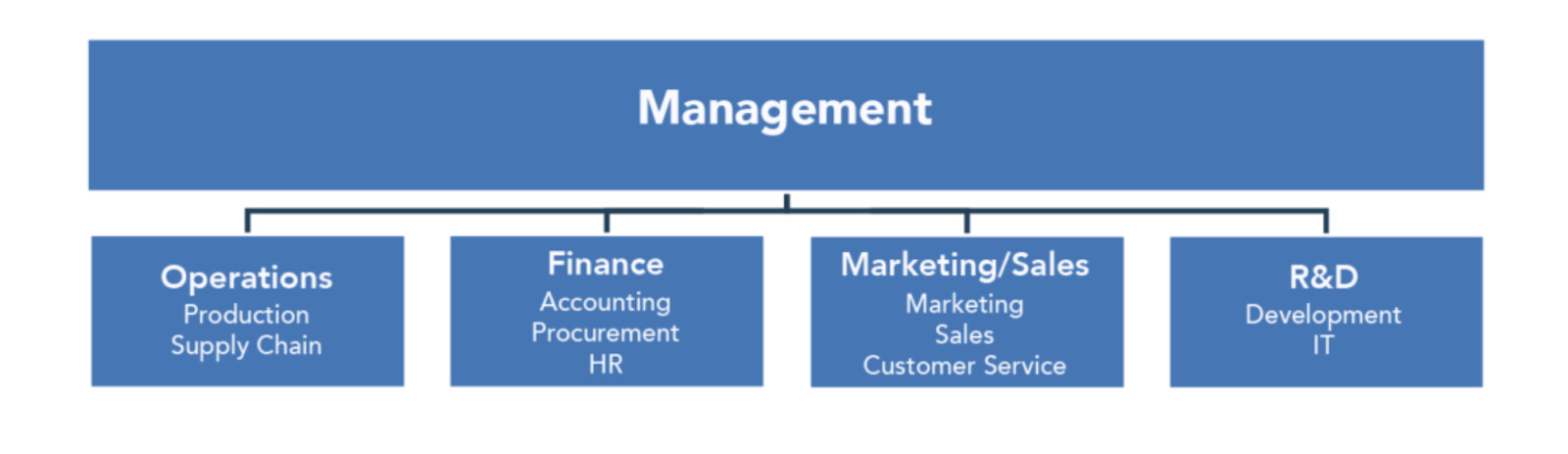
The hilarity is embedded in that Lumen article itself. The definition of every other major functional area takes up significantly more space than operations! The “heart of a business” gets three lines! You can’t make it up!
What I think the Lumen Learning definition is trying to get at is this - Operations is the part of an organization that creates the value that people really care about.
What does that mean? Let’s begin with the other functions and examine the value they create.
The value Marketing and Sales creates is fundamentally for the organization they serve. There’s nothing wrong with that. Their first goal is to generate streams of cash. That’s their job. That job can be done in alignment with customers’ intentions, but it’s not a strict requirement. Ask any account executive: it is definitely a strict requirement to bring in those streams of cash. You can’t be a rainmaker if you don’t make rain.
Finance is its own beast. The value it creates is keeping its home organization alive. It’s like an impersonal circulatory system. Its alignment with people depends on the particular person at a particular time. If a person has a strong interest in the organization continuing to exist - well then they’re aligned. If a person has an open account receivable they don’t want to pay- then they’re misaligned. An organization’s stock of cash is its animating life force. To keep it healthy, it’s not enough to buy and sell, you have to pay and get paid. Finance’s value is about that last part.
One other thing I’ll say about Finance. People like free. My experience is finance is not about free.
The Lumen article misses defining Research and Development (R&D), but I would (and many organizations do) lump them into Operations anyway. So no loss.
That brings us back to - what does it mean for Operations to create the value people really care about? What does it mean to be the heart of a business?
Do you value the machine you’re reading this on? Or your breakfast? Or the clothes on your back? Or anything else you own or consume? How were you able to buy those things?
Not: what are they . . .
Not: why did you. . . .
How were you . . .
How.
Well . . . Someone thought of it. Someone designed it. Someone made it. Someone brought it to you.2
That chain is Operations. It’s the part of an organization that conceives, designs, makes, and gets to you the stuff you want to buy, own, and use.
Take the machine you’re reading this on.
It began as an idea in someones mind, based on thousands of other ideas from a huge diversity of Thinkers. Thinkers love ideas, but they also love what ideas can do for you.
Their days look very boring from the outside. They sit at desks, draw on boards, drink coffee. But in their minds is a massive, forbidding, and constantly evolving landscape they venture into. They encounter the terror of the absolute unknown in all of its danger. A lot of their professional life is holding their fear at arm’s length to give their mind time to map this landscape. They bear this fear partially because they care about you and what you might do with newly discovered territory - a new idea. How that idea might serve your intentions.
Once the most dangerous unknowns have been shorn from the idea, it gets passed to a team of Designers who lovingly craft a design for building it. They begin with you and your needs and shape the design to accommodate them. Their days are filled with careful iteration. They shape a part of their work, think about you and how it fits your needs, bring it to other designers from different disciplines or expose it to merciless experiment, get feedback, then they go and do another iteration. They are constantly, all the time, exposing their art to criticism and the emotional toll that takes.
See, when you make something you find beautiful and someone criticizes it, that can feel personal. It can feel like your essence is being criticized even though that’s often not what’s happening. Designers bear this emotional challenge because they know that’s how to practice their art honestly. At their best, they surrender completely to the process while still holding strong convictions about how to serve you. They become an instrument of the process. To serve your intentions.
Once the design is formed up, it gets passed off to Builders. Their days are filled with discipline. You will find a Builder often at work with focused attention on a painfully delicate task. This is their struggle: to show up with humility every day to the same work. Trying to do it perfectly while always knowing it can never be perfect. This condition creates a very strange dualism.
Because it needs to be perfect: Errors are their enemies. Builders are, all the time, everywhere fighting entropy - literally the universe - for you. An error in their work could be carried by the product all the way to you. That error could prevent you from getting value or - much worse - harm you. So the errors have to go. The discipline this demands is cold and precise and exacting.
Because it is always imperfect: they must constantly adjust their processes and methods to make them better. This work is incredibly creative and hard because it’s filled with ferocious complexities and unintended consequences. This tightrope walk between discipline and improvisation is for you. And your intentions.
The Builders pass off their components and the finished product to Logisticians. Their craft is literally flow. The flow of materials and products around the world. Their tool and their enemy is time. All the time everywhere they are under deadline. This pressure is coupled to an almost total lack of control.
A factory is a controlled environment. It allows you to eliminate variables until you’re just manipulating the ones you want. The domain of the Logistician: the open sea, the tangled air, the vast landscape - they obey no man. This tension between precise timelines and unknown conditions is where their craft lives.
Logisticians are a swashbuckling bunch. They delight in snafu. Speaking with them you might mistake their humor for lack of care. It’s the opposite. The humor is the care. Logisticians can never get committed to one way or mode. Their chief concern is getting you your product on time. In that way, their work is pure intention and they select their methods by no other standard. Their struggle is constantly turning away from the safety of regularity to find the next move that works. They have nowhere to hide from the world’s unrelenting flow of change. They wake up and face that flow because to fail makes the whole system stop. The system that serves your intentions.
This is true of the machine in front of you. It’s also true of the operating system that works on the machine, the website you’re using to read this, the servers that website operates on, the food in your kitchen, the materials that assemble your home, the air conditioner operating in the background3.
This is Operations in its full generality - the massive web of connection and flow happening all around you all the time in service to you and the people around you. It can’t not be that. Its intention is to give you value. The purpose of a system is what it does4.
You can see now that this captures huge and essential parts of the economy - farming, raw material extraction, construction, manufacturing, supply chain, logistics, product development, software development and deployment. The literal guts of civilization.
It is also the backbone of the oldest human organizations - militaries.5 In fact, the hilarity extends all the way back to Alexander the Great6:
My logisticians are a humorless lot, for they know if my campaign fails they will be the first I slay.
The Alexander quote feels true to me. At least the part about slaying. Operations has this quality that when it’s done well - you never notice it. When it fails, it’s catastrophic. And almost always presages an epic ass chewing.
I doubt he was right about the humorless part. My experience says Operators are darkly funny, salt of the earth folk.
Thinkers, Designers, Builders, Logisticians - all are operators. An operator is a person whose craft is in the flow of value directed at you.
I think something that distinguishes this tribe from others is that - they always have to think about you. Often those thoughts are in the abstract, but their feelings for you are usually concrete. From my perspective - and I’ve done a lot of operational jobs in my life across a wide variety of contexts - they care about you. We’re still speaking in averages here and the motivations for the care are not generally selfless. But, this might surprise you, the motivation often includes just genuine care for you. That’s true from my perspective. It’s definitely true for me.
But the beauty of the thing is that the motivation doesn’t really matter that much. Whatever their motivations, their intentions are aligned with yours fundamentally. Their job is to give you what you want. If they don’t do that, well - on average - they don’t get to do their job anymore.
So why is it so hard to find information about Operations? Well, about that . . .
Our work shows up as absence. Absence of friction. A good operator is one you never have to think about. Think about it - when was the last time you couldn’t locate a product you wanted to buy? It’s probably a rare occurrence. Things generally just work for you. They flow.
Yeah. We’re pretty good at our jobs. That’s why we don’t have a wikipedia article.
And if the body were not the soul, what is the soul?
Walt Whitman - I Sing The Body Electric
At the time of this writing. You can, of course, point to Operations Management - the academic field that studies operations, but that’s like linking the article on color theory to the word painting. One is about theory and the other is about practice. One can know color theory and not know how to paint. I don’t think it works the other way though.
Or a place you could pick it up.
How many times did I use cognates of operate in this paragraph? See? As my dad would say “if it was a snake, it would have bit ya!”.
Stafford Beer. You strange brilliant mind you.
“Amateurs talk about tactics, but professionals study logistics.” - Gen. Robert H. Barrow - 27th Commandant of US Marine Corps.
Probably apocryphal, but we’re just having fun now.